Non‑Trading Goods and Services in the VIT System
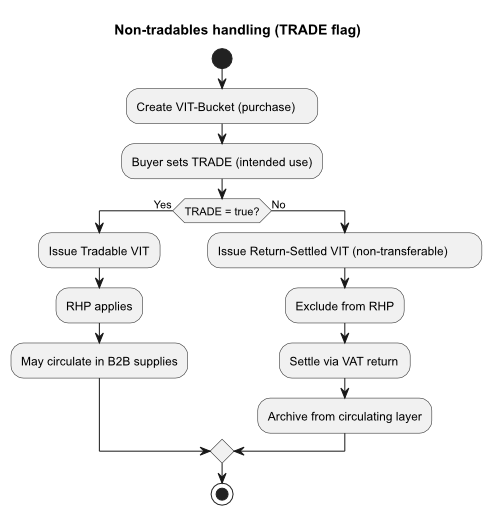
This page explains how the VIT model treats non‑tradable (internal‑use) purchases—capital goods, consumable goods, and consumable services— without changing the substantive VAT policy of allowing input credit where inputs support taxable activity. The core idea is simple: RHP applies only to tradable inputs, while non‑tradables are return‑settled and removed from the circulating token layer.
1. Why the split exists (tradable vs non‑tradable)
A Reasonable Holding Period (RHP) is a control that only makes sense for inputs expected to circulate as onward supplies.
Applying RHP to long‑life assets and ordinary overheads would generate disputes and administrative noise.
Therefore, the VIT system uses a boolean flag TRADE to determine whether a purchase creates a transferable, RHP‑relevant token or a return‑settled record.
2. Definitions
- Tradable inputs (TRADE = true): inputs intended to be onward supplied (goods for resale, materials that become outputs, and on‑supplied/recharged services).
- Non‑tradable inputs (TRADE = false): inputs intended for internal consumption (capital goods, consumable goods, consumable services, and mixed‑use overheads).
3. Token behaviour
Important: “Purging” for TRADE = false means archiving after return settlement, not denial of credit.
TRADE=true  → Tradable VIT (transferable) → RHP applies → used in B2B flows / supply chain
TRADE=false → Return‑Settled VIT (non‑transferable) → no RHP → settled via VAT return → archived
4. Periodic VAT return disclosure (totals schedule)
To discourage loose use of TRADE = false and to support cross‑tax analytics, the return includes totals of non‑tradable purchases by category.
This is totals‑based (not item‑level), and can be mapped from the general ledger / chart of accounts.
| Return Field Code | Category (Non-tradables) | Examples | Primary control use |
|---|---|---|---|
| NT‑01 | Capital goods (non-tradable) | Plant, machinery, IT equipment | Cross‑check with income tax depreciation and disposals |
| NT‑02 | Consumable goods(internal) | Stationery, minor spares, supplies | Ratio and trend analysis (industry bands) |
| NT‑03 | Consumable services(internal) | Rent, utilities, professional fees | Vendor concentration and spike detection |
| NT‑04 | Mixed‑use / restricted inputs | Shared overheads partly exempt | Apportionment validation |
| NT‑05 | Reclassifications (net) | TRADE true↔false journals | Audit trigger if frequent/late-period |
| NT‑06 | Total TRADE=false VIT received | All return‑settled records | Discourage overuse; consistency check with NT‑01…NT‑04 |
5. Reclassification (trade ↔ non‑trade)
Business reality can change. A light reclassification mechanism is therefore required:
- Corrections window: allow reclassification within a short, defined window (e.g., same period or a prescribed correction period), with a reason code.
- Event log: record reclassifications as journal events to support audit analytics (especially late‑period reclassifications).
- Mixed‑use: where appropriate, allow an “intended taxable ratio” to support partial restriction and later change‑of‑use adjustments.
6. Compliance analytics (VAT + Income Tax)
The aim is not to create new burdens, but to create useful signals for targeted compliance:
- Unusually high
TRADE=falsetotals compared to turnover (sector‑normal bands). - Capital totals (NT‑01) inconsistent with income tax depreciation schedules and fixed‑asset disclosures.
- Repeated reclassifications (NT‑05), especially late‑period or concentrated by vendor/category.
- Vendor concentration patterns in consumable services (NT‑03) that correlate with known evasion typologies.
7. Suggested legal insertions (website “Legal Amendments” section)
The following insertions can be drafted in a technology‑neutral way (paper‑capable), while enabling digital implementation. Suggested placement is: (a) Definitions, (b) VAT return content/schedules, and (c) record‑keeping provisions.
7.1 Definitions (add to the definitions section)
- “Tradable input” and “Non‑tradable input” (based on intended onward supply vs internal use).
- “Return‑Settled deferred VAT record” (a non‑transferable record eligible only for settlement through the periodic return).
- “Reclassification event” (a prescribed adjustment from one category to another, subject to conditions and records).
7.2 VAT returns (add to the return section / prescribed form power)
- Empower the CGIR (or relevant authority) to prescribe a schedule requiring totals of non‑tradable inputs (NT‑01…NT‑06) as part of the VAT return.
- Permit the authority to prescribe categories, thresholds, and reason codes, and to revise them by notice/gazette.
7.3 Record keeping (add to record‑keeping section)
- Require a capital goods schedule (or link to the income tax fixed‑asset register) sufficient to identify disposals and major reclassifications.
- Allow records to be kept in any manner prescribed, including electronic form, so long as authenticity and auditability are maintained.
8. Suggested site navigation updates
- Add this guide to your “Guides” list and header menu as:
['label' => 'Non‑Tradables', 'href' => '/guides/nontradables.php']. - Cross‑link from: VIT Buckets (classification occurs at bucket creation), Mutability (why non‑tradables must not circulate), and Fraud Prevention (risk indicators and cross‑tax analytics).
- Add concise definitions to Core Definitions: Tradable input, Non‑tradable input, Return‑Settled VIT, Reclassification event.